
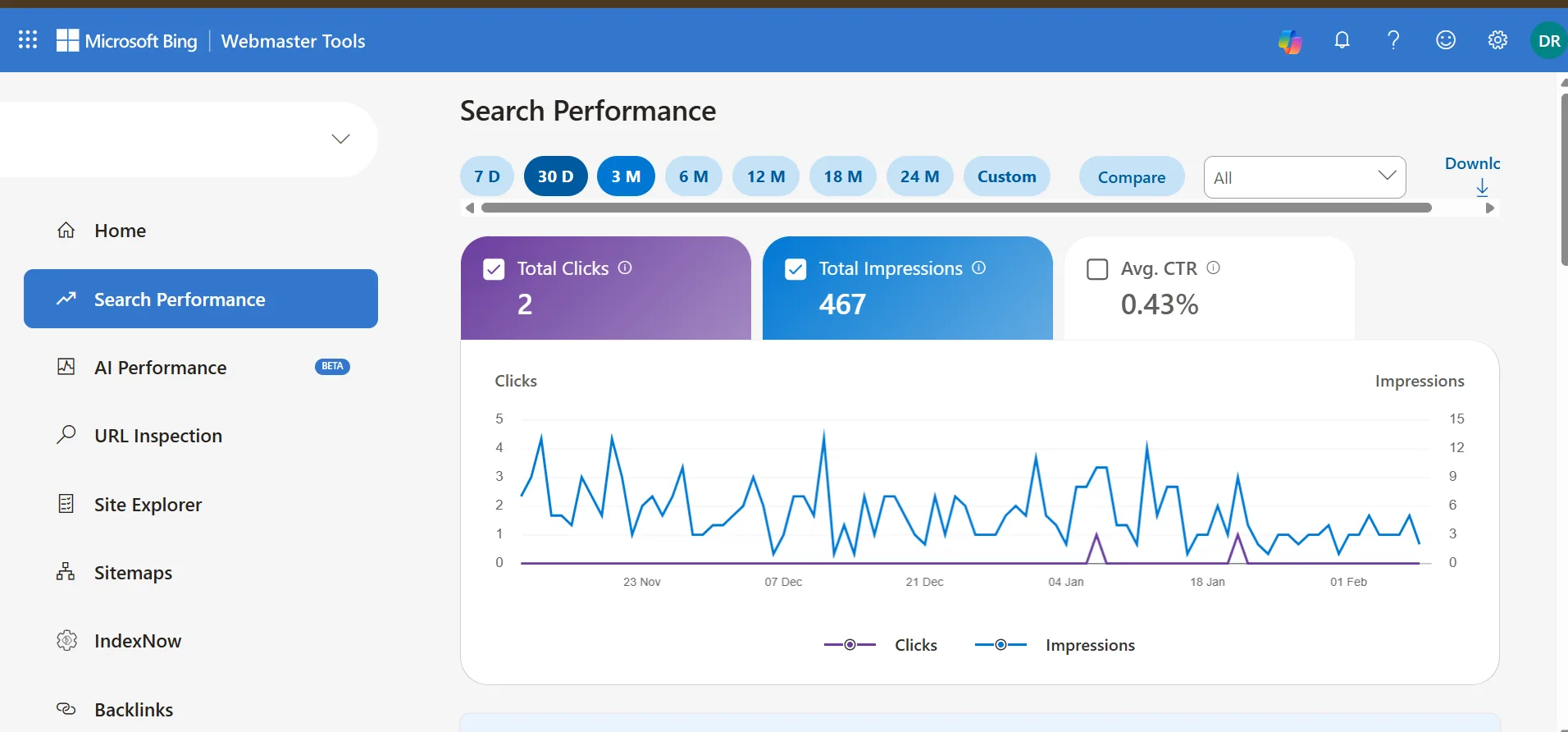
Bing has introduced AI Performance (Beta) inside Bing Webmaster Tools, giving site owners a dedicated way to view how their content performs in AI-powered search experiences.
This matters because it treats AI visibility as a first-class layer of search, not a side effect of modern SERPs. Until now, AI answers influenced impressions, brand recall, and user decisions without offering publishers a clean way to understand that impact. Bing’s move begins to close that gap.
More importantly, it sets expectations for the rest of the ecosystem.
Why AI Performance Needs Its Own Reporting Layer
Classic search reporting was built on a stable assumption: ranking leads to clicks, and clicks represent value.
AI-powered search changes that behavior. Content can now shape answers without being clicked, appear across multiple responses without holding a stable “position,” and increase impressions while reducing CTR. These patterns are already visible if you understand how AI-driven search systems operate under the hood.
This behavior becomes clearer once you understand how Google’s AI Mode works, particularly how answers are generated and why traditional ranking logic no longer applies.
By separating AI Performance from traditional Search Performance, Bing is acknowledging something important: answer visibility and link visibility are not the same thing, and measuring them through a single lens creates blind spots.
What This Means for Google
The obvious follow-up question is whether Google should introduce similar reporting.
From a technical perspective, Google can. From a strategic perspective, the challenge is how to frame it without redefining success overnight. Search Console has always been query- and click-centric. AI Overviews operate on synthesis, not retrieval.
A realistic rollout from Google would likely be incremental:
- High-level AI visibility metrics before granular detail
- Emphasis on exposure or participation rather than direct attribution
- Clear separation between classic results and generative answers
This shift also explains why brand mentions are gaining importance over backlinks in AI-driven SEO environments, especially when visibility is driven by synthesis rather than retrieval.
Once Google acknowledges AI answers as a measurable surface, the definition of “performance” inevitably expands beyond clicks.
Looking Ahead: If ChatGPT Introduces Webmaster Tools
If ChatGPT ever launches a publisher or webmaster interface, it will not resemble Search Console or Bing Webmaster Tools.
The reason is simple. ChatGPT doesn’t think in queries. It operates on topics, concepts, and relationships.
Instead of keyword-based reporting, such a system would likely focus on topical contribution, showing:
- Which subjects your content meaningfully supports
- Where your explanations are trusted
- Which related concepts are thin, missing, or inconsistent
This aligns with the broader set of SEO strategies required to adapt to AI-powered search, where depth, clarity, and topical consistency matter more than exact-match targeting.
How Attribution Would Differ
Generative systems don’t retrieve single documents. They synthesize information across many sources.
As a result, attribution would be probabilistic rather than exact. Reporting might include contribution ranges, primary versus supporting roles, or frequency of conceptual inclusion across answers.
This would feel uncomfortable for SEOs used to deterministic metrics, but it would be far more honest than pretending AI behaves like traditional search.
A Shift Toward Editorial Feedback
Another major difference would be the nature of feedback itself.
Rather than rankings or CTR changes, a ChatGPT-style console would likely highlight gaps in explanation, missing constraints, generic coverage, or a lack of real-world examples.
That’s not technical SEO feedback. It’s editorial feedback, which makes sense because AI systems evaluate usefulness the same way humans do: by clarity, completeness, and applicability.
Traffic Becomes a Secondary Outcome
In an AI-first measurement model, traffic doesn’t disappear, but it stops being the central signal.
Primary indicators of success shift toward:
- Inclusion in answers
- Depth and consistency of topical coverage
- Alignment with updated knowledge
Clicks become a consequence, not the objective.
What Bing’s Update Really Signals
Bing’s AI Performance report isn’t a finished framework. It’s an early signal that search measurement is finally catching up with how search actually works today.
Google will likely follow with its own interpretation.
AI platforms like ChatGPT may redefine the model entirely.
The real question is no longer just how to earn visits, but how to contribute understanding at scale. Bing’s update is one of the first visible steps toward measuring that shift properly.

