We used to understand proximity as distance. A shop three kilometers away was farther than one at half a kilometer. The closer option appeared first, or at least higher in the list. The system measured, sorted, and presented accordingly. This model worked because it matched how we moved through physical space. Distance determined effort, and effort shaped choice.
That understanding breaks down when you search for “dentist near me” from a Delhi metro station and the results exclude a clinic 200 meters away in favor of one across the highway, twenty minutes farther by foot. The system did not make an error. It made a decision about what belongs in your consideration set before it began ranking anything at all.
This explains what you’re seeing in your Google Business Profile dashboard right now. Your clinic appears for “dentist near me” in one neighborhood consistently, then vanishes completely for searchers three streets over. The GBP insights show impressions dropping by 60% with no change to your listing, no new competitors, no algorithm update announcement. The proximity threshold moved, and you fell on the wrong side of it.
Proximity now operates earlier in the process than most people realize. It functions as a filter that determines eligibility before the familiar ranking mechanisms engage. This shift happened quietly, driven by the collapse of time between query and action in mobile search environments. When someone searches while standing on a street corner in Pune, exhausted after work, looking for a pharmacy that stocks a specific medication, the search system does not have the luxury of presenting ten careful options and waiting for deliberation. It has to decide what qualifies as relevant in that moment, under those constraints, for that person.
The change matters because proximity now behaves like a threshold rather than a gradient. An entity either belongs in the result set or it does not. Small shifts in how the system perceives your location, your intent, or your behavior can move you across that threshold in ways that feel sudden and absolute. The frustration many SEOs experience today comes from working with an outdated mental model, one that assumes proximity is calculated during ranking when it actually shapes eligibility long before ranking begins.
What Proximity Actually Means in Search
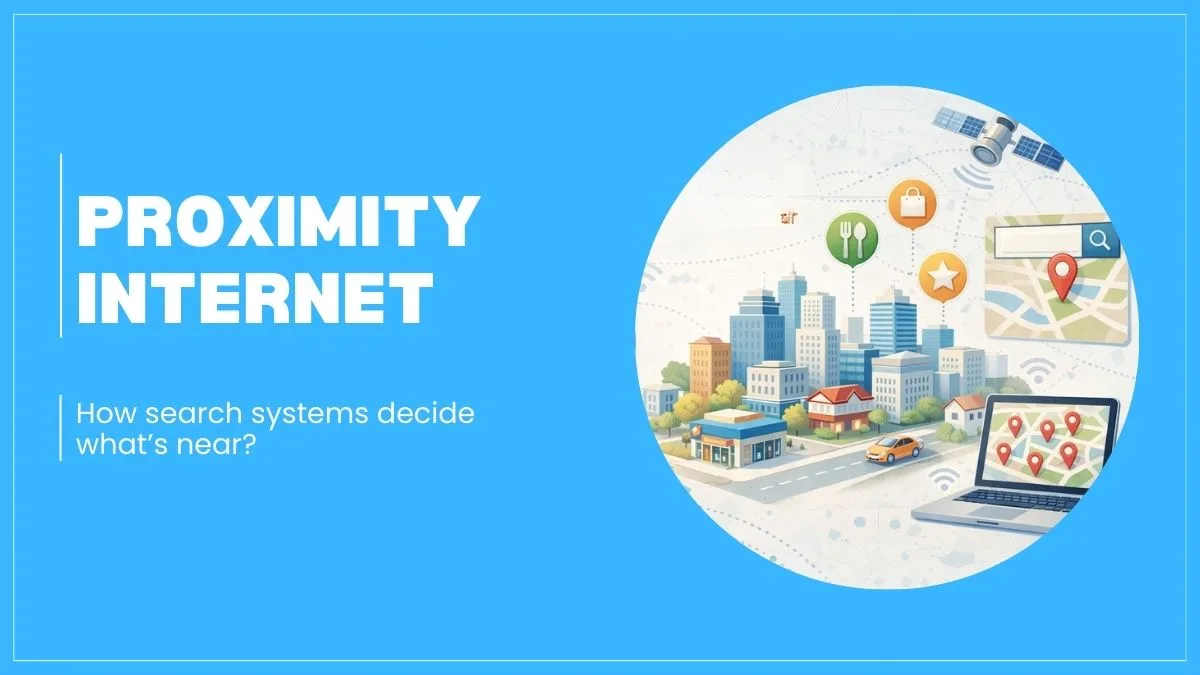
In search, proximity describes how search systems determine relevance based on nearness. It can mean physical distance between a user and a place, contextual closeness between concepts in content, or relational distance within data graphs. Proximity helps search engines decide what is “near,” “related,” or most immediately relevant to a query.
For example, when a user searches “coffee shop near me,” proximity primarily refers to physical distance, ranking businesses closer to the user higher. In informational searches, proximity works differently. If an article discusses “AI search” and repeatedly mentions “semantic understanding” and “LLMs” in close contextual alignment, search systems infer stronger relevance between these ideas.
Proximity also operates within entity relationships. A brand frequently associated with a category, use case, or location becomes “closer” in the search system’s understanding. In all cases, proximity reduces effort for the user by prioritizing results that feel immediately useful, connected, and situationally appropriate rather than merely keyword-matched.
The rest of this article explains how search systems make these belonging decisions, why they work this way, and what that means for anyone trying to understand or influence their visibility. The mechanics are complex, but the underlying logic is consistent. Search systems try to reduce their own uncertainty about which options will actually work for people trying to accomplish something right now. Proximity filtering is how they express and enforce that goal.
Search Begins With Uncertainty, Not Answers
When a query enters the system, there is no clear intent waiting to be fulfilled. There is only a string of words and a weak set of clues. A query like “cardiologist Bangalore” does not tell the system whether the person is panicking, researching, comparing, or planning months ahead. Yet the system must act as if it understands, because hesitation is failure.
So it guesses. But it does not guess randomly.
Search systems infer intent by watching what people actually do. They study patterns in query structure, timing, device type, and location precision. They compare today’s query against millions that looked similar in the past and ask a brutal question: what happened next? Click, call, visit, abandon, refine. Over time, these outcomes harden into expectations.
You can see this learning in your own data. The same keyword behaves differently at different hours. “Gym near me” in the morning leads to visits. The same query at night rarely does. The system stops treating them as the same search. Morning intent becomes action. Evening intent becomes curiosity. Rankings shift not because someone tweaked metadata, but because the system learned when people follow through.
This is where the illusion of “broad search” breaks down.
Exploratory queries can tolerate messiness. Someone browsing “best Italian restaurants in Mumbai” has time. The system can show range because the cost of being slightly wrong is low. The user will scroll, compare, and decide.
Action queries do not have that luxury. A late-night search for “emergency vet” is not research. It is a demand for correctness. One closed clinic or one impractical distance is enough to break trust. In these moments, the system stops optimizing for choice and starts optimizing for risk reduction.
Modern search reflects this shift. The system now decides who is eligible before it decides what to show. Inclusion matters more than position. If you are filtered out early, you are invisible no matter how strong your brand, content, or reviews are.
Uncertainty forces this behavior. Search cannot afford to surface everything and hope the user figures it out. It must exclude aggressively. Proximity becomes one of its most reliable filters, not because distance is inherently valuable, but because reachability is a defensible signal when intent is unclear.
Search narrows not because it wants to, but because uncertainty leaves it no choice.
Why Proximity Exists Long Before Search
Proximity functions as a natural organizing principle in the physical world. Long before digital systems, relevance was determined by context, constraints, and shared conditions.
A kirana store in any Indian neighborhood makes this obvious. Its inventory reflects local habits, seasonality, and buying rhythms. The shopkeeper does not try to stock everything. The store carries what moves quickly, fits the space, and serves the immediate needs of the community. Relevance here is practical, not exhaustive.
This is proximity acting as a validity filter.
The kirana store does not compete with a hypermarket ten kilometers away by expanding choice. It survives by operating within the same constraints as its customers. Speed, familiarity, trust, and convenience matter more than scale. Proximity, in this context, means belonging to the same everyday reality.
Search systems inherit this logic rather than invent it. When a query arrives with location and urgency signals, the system evaluates what belongs before it evaluates quality. Physical reachability matters, but so does whether an entity has repeatedly served similar needs in similar contexts.
Proximity, in both physical and digital systems, determines membership before preference. It decides who is even considered long before comparison begins.
When Mobile Search Turned Queries Into Decisions
Mobile search collapsed the distance between wanting something and acting on it. If you are searching on your phone, you are usually already in motion. You are walking, waiting, stuck in traffic, or dealing with something that cannot wait. This is not research time. This is decision time.
Desktop search allowed patience. You could open tabs, compare options, and come back later. Mobile search happens in the middle of life. Even when the query looks neutral, the context tells the system otherwise.
In Indian cities, this pressure is hard to miss. You know that two kilometers does not mean two minutes. A place that looks nearby on a map can be impossible to reach during peak traffic. A clinic or store may technically be open, but not practically accessible. When you search late in the evening, you are not asking for the best option in theory. You are asking for something that will work now.
This is where intent shifts from planning to execution. If you search “hardware store” while standing in your under-construction home, you are not browsing. You need a place that is open, reachable, and likely to have what you need immediately. The system understands this because people in your situation behave the same way. They either act right away or leave.
Search systems adapted to this reality. On mobile, showing too many options creates friction. It forces you to evaluate feasibility yourself: what’s open, what’s reachable, what’s worth the effort. That cost is high when you are already under pressure.
So the system filters early. It first decides what is realistically reachable in your moment, then ranks within that smaller set. Proximity becomes the shortcut for feasibility, not because distance alone matters, but because it reduces the risk of wasting your time.
This is why your local traffic does not decline gradually. It drops or spikes. One week you receive steady calls, the next week it falls off a cliff. From your side, nothing changed. From the system’s side, a boundary shifted. You moved slightly in or out of eligibility. The system did not punish you. It simply adjusted who it trusts to show when someone like you is searching under pressure.
Why Distance Fails as a Primary Signal
Distance measures space. You navigate feasibility.
You already know this from daily life. A café five hundred meters away can feel farther than one over a kilometer away if the closer option means traffic chaos, no parking, or an unpleasant walk. Distance on a map does not reflect effort, convenience, or likelihood of follow-through. Treating it as a primary signal assumes people move like straight lines. They don’t.
Search systems learned this the same way you did: by watching what actually happens.
When people repeatedly ignore a closer option and choose a farther one, that behavior leaves a trace. Over time, the system sees patterns emerge. From certain neighborhoods, at certain times, people consistently travel farther for specific needs. The outcome matters more than the geometry.
This becomes obvious in dense cities. You might live in one area but consistently choose services in another because they sit along your commute, feel easier to reach, or fit better into your routine. The system notices that you and others like you behave this way. Distance stops being predictive. Practical access takes over.
You can see this in your own local data. Searches and visits come from areas you did not expect. Not because the system misread geography, but because it learned who actually shows up. Enough successful visits from a particular area turn into confidence. That confidence overrides distance.
What the system ultimately trusts is not closeness, but reliability. Which entities people reach. Which ones they act on. Which ones consistently resolve the need. Proximity shifts from measurement to expectation.
At that point, distance becomes secondary. The system is no longer asking which option is nearest. It is asking which option people like you actually choose and follow through on.
Proximity as an Eligibility Decision
Every query triggers two decisions, even though you only see one. First, the system decides who qualifies to be considered. Only after that does it rank the eligible options using relevance, authority, engagement, and prominence. Most SEO effort lives in the second stage. Most visibility problems are created in the first.
Eligibility works like a gate, not a gradient. You are either inside the set or you are not. There is no “almost visible” state. This is why local visibility feels binary. One month your business appears consistently. The next month it disappears. From your side, nothing changed. From the system’s side, confidence dipped just enough for you to fall outside the gate.
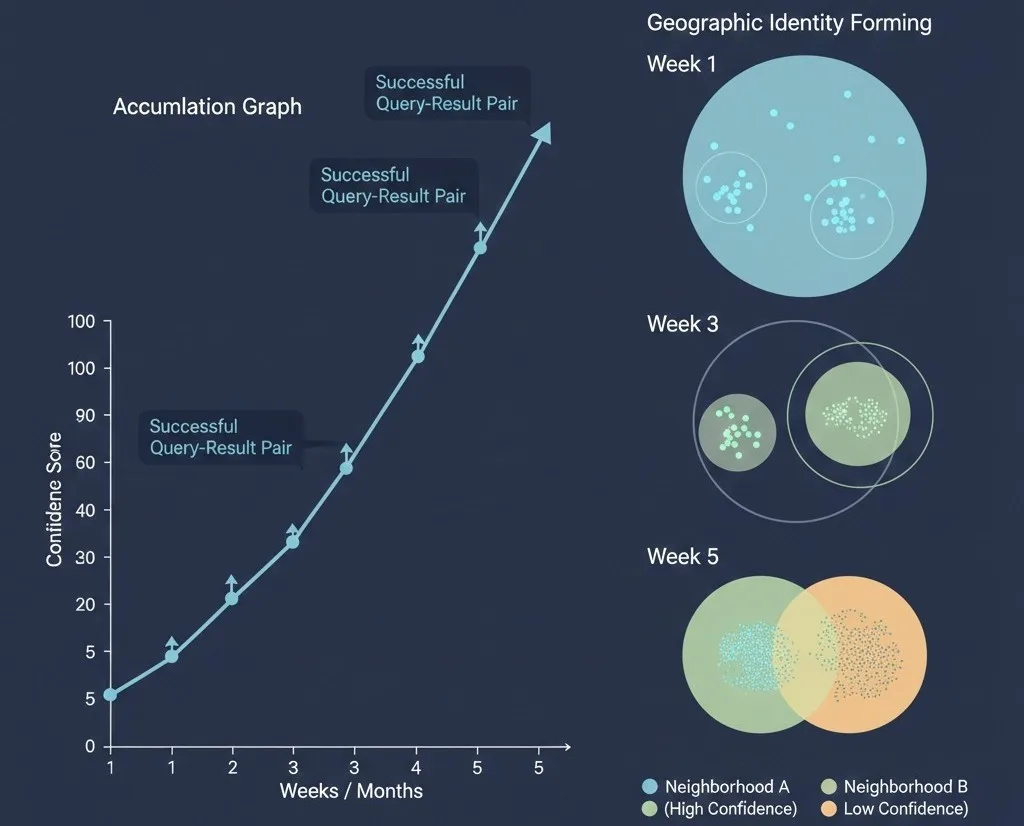
That confidence is not recalculated fresh for every search. It is accumulated over time. The system asks a simple question: Have I seen enough evidence that this business reliably satisfies this kind of query from this kind of location? If the answer is yes, eligibility is granted. If the answer is uncertain, eligibility is withheld. The decision is fast because the learning happened slowly.
This is why months of optimization can feel useless. You fixed technical issues, improved content, added schema, collected reviews, stayed active on your profile. Your metrics improved. But your visibility didn’t, because you were optimizing ranking signals while still outside eligibility. You were polishing performance in a race you were not yet allowed to enter.
You can see this gap clearly if you look at your own data. Compare the queries where your business appears to the ones it logically should appear for but doesn’t. That gap is not a ranking failure. It is an eligibility failure. Until the system believes you belong in that query-location context, no amount of refinement inside your profile will matter.
Search results only show the second stage. They display ranked entities that already passed the filter. Everything excluded remains invisible, along with the reason it was excluded. Eligibility exists precisely to reduce uncertainty. And until you clear it, the system behaves as if you don’t exist for that search at all.
How Search Systems Infer Proximity Over Time
Search systems don’t recalculate proximity every time someone searches. They rely on memory. Over time, the system forms an opinion about where your business actually works, not where it is pinned on a map.
That opinion is built through repetition. When people from a particular area search for a service and then choose your business, visit, call, or return, the system connects the dots. One interaction does not matter much. Dozens of similar outcomes do. Slowly, your business starts to feel like it belongs to that area in the system’s understanding.
If you operate in India, you’ve probably seen how messy this gets. Your customers don’t come from neat circles around your location. They come from specific pockets. A few neighborhoods send steady footfall. Others appear only on weekends or for specific needs. Some areas never convert at all, even if they are physically closer. This is normal human behavior, not a tracking error.
Search systems adapt by learning patterns instead of drawing boundaries. They watch where searches originate, when they happen, and what people do next. Over time, they build a mental map that looks less like a radius and more like a set of connected clusters. Where engagement is consistent, proximity strengthens. Where it is sporadic, proximity stays weak.
You can see this yourself in your Business Profile data. Views and actions cluster around certain pin codes that don’t align with distance alone. These are not random. They reflect where the system has confidence that people actually follow through when your business appears.
At this point, proximity starts to behave like reputation. It isn’t granted because you are nearby. It is earned because you reliably satisfy people from that area. Serve an area consistently, and proximity grows. Fail to convert interest into outcomes, and proximity fades, even if you are close.
What matters most is consistency, not reach. Occasionally attracting someone from far away doesn’t build proximity. Regularly serving people from the same area does. The system prefers predictability because predictability reduces uncertainty, and reducing uncertainty is the whole reason eligibility filtering exists in the first place.
How Proximity Becomes Personal
Search systems don’t apply proximity the same way to everyone. They adjust it based on how you behave.
Over time, you teach the system how much constraint you can tolerate. Some people search when they need to act immediately. Others search to explore, compare, and decide later. The system learns the difference and responds accordingly.
If you tend to search and then call, visit, or navigate right away, the system treats you as action-oriented. For you, proximity tightens. The consideration set shrinks. Only options that are highly likely to be reachable and operational make the cut. Showing something impractical costs too much because you are likely to act on whatever appears.
If you tend to search, read reviews, save places, and return later, the system relaxes. Distance matters less. Availability matters less. The search is interpreted as research, not execution. You are given room to browse because history shows you won’t act immediately anyway.
You can see this yourself. Search for a service after weeks of related activity and compare the results with someone else nearby searching the same term. The results will differ. One of you will see tightly constrained, immediately usable options. The other will see broader, more varied ones. Same query. Same location. Different expectations.
Think about a Saturday morning search for “café” in Indiranagar. If the system knows you usually search while already out and tend to visit within thirty minutes, it keeps results within walking distance. If it knows you usually search from home and visit later, it includes cafés across the city that match your preferences, even if they require a drive.
What changes is not the query or the map. What changes is the system’s belief about how you make decisions.
This personalization happens quietly. You are not asked. You are not notified. You simply search, act, or delay. The system watches, learns, and adjusts. Over time, proximity becomes personal. Not because the system wants to customize results, but because predicting your behavior reduces uncertainty. And reducing uncertainty is the system’s primary job.
The Real Role of Google Business Profile
Google Business Profile sits at the center of how search systems build confidence. It gives the system a single, dependable place to resolve basic questions before deciding whether a business should be considered at all.
When someone searches with urgency, the system cannot afford slow deliberation. It needs to know where the business is, whether it is open, what it actually offers, and whether it appears to be actively maintained. The Business Profile supplies these answers quickly, reducing hesitation at the eligibility stage.
Each complete field lowers risk. Accurate hours make time-sensitive inclusion safer. A precise location pin improves reachability assessment. Clear categories sharpen intent matching. Recent reviews and responses suggest the business is active and accountable. None of these force visibility, but together they remove reasons for exclusion.
Look at your profile through this lens. Are your hours reliable across weekdays, weekends, and holidays? Does your primary category reflect why customers choose you? Does the pin guide people to the correct entrance? Have you engaged with reviews recently? These details function less like optimizations and more like trust signals.
Profile activity plays a similar role. Regular posts do not push rankings upward, but they indicate ongoing attention. An actively managed profile tells the system that other information is likely current. That assumption lowers uncertainty, which matters most in marginal eligibility decisions.
The Business Profile does not create demand or authority. It creates observability. It allows the system to include you confidently and then learn from what happens next. Visibility grows only after people see you, choose you, and follow through. The profile simply makes those outcomes possible by removing doubt at the gate.
What This Means for SEO Work
SEO used to feel like a race. Improve pages, earn signals, move up. That logic breaks when visibility depends on eligibility instead of ranking.
At that point, the work changes. The goal is not to climb higher. The goal is to be included.
The system first decides whether your business belongs in a query’s consideration set. Only after that does ranking matter. If you are not eligible, every optimization you make stays invisible.
To improve eligibility, focus on three practical areas.
1. Be clear about where you operate
Decide what geography you actually serve and signal it precisely. If your clinic serves three neighborhoods, make that obvious in your profile, categories, and service descriptions. Avoid vague categories chosen to “reach more people.” Precision helps the system place you correctly.
2. Be consistent everywhere
Your Business Profile, website, and directory listings should tell the same story. Same address format. Same phone number. Same service language. Small mismatches reduce confidence and delay inclusion.
3. Serve the users who find you
Eligibility grows through behavior. Answer calls and messages quickly. Keep hours accurate. Respond to reviews. When people find you and successfully act, the system records that outcome. Repetition builds trust.
Here’s how to check where you stand.
Open your Google Business Profile and look at the queries generating impressions. These represent the contexts where you are already eligible. Now list the queries you want to appear for but don’t. That gap is your real SEO problem.
Ranking improvements matter only after eligibility stabilizes. Until then, SEO is not about optimization. It is about alignment. Make it easy for the system to understand where you belong, then prove it through consistent real-world outcomes.
Different search interfaces look different, but they all behave the same way at the core. Each one decides who belongs in the answer first, and only then decides how to present it.
In Google Search, this shows up as the local pack. Three businesses get prime visibility. Everything below exists, but most users never reach it, especially on mobile. If you are not inside the eligibility set that feeds the pack, your ranking below it barely matters.
Google AI Overviews compress this even further. A query like “best pediatrician near me” results in two or three named options inside the AI response. Those names were selected before any text was generated. If you are outside that shortlist, you are not mentioned at all. There is no scrolling past you. You simply don’t exist in that answer.
ChatGPT search follows the same logic. When it suggests one or two laptop repair shops in a specific area, it is not browsing live options. It has already filtered the universe down to businesses it considers feasible for that context, then speaks from that reduced set.
Perplexity makes the process easier to notice. You see citations, but only for sources that survived filtering. Hundreds of potential options were excluded earlier. You never see them.
What changed is not the system’s logic. What changed is the number of visible slots. Ten blue links allowed exclusion to feel survivable. AI-generated answers with two or three mentions make eligibility absolute.
If a competitor shows up in AI responses and you don’t, the issue is rarely bias or randomness. It means you were not part of the eligibility set the system trusted for that query and context.
Across every interface, the work stays the same:
help the system clearly understand where you operate, what you reliably serve, and who consistently succeeds with you. Ranking happens later. Belonging happens first.
Conclusion: Search Runs on Constraint
Proximity now functions as an eligibility filter in search. Before anything is ranked, the system decides who qualifies to be considered. That decision exists to reduce uncertainty in moments where users are likely to act.
This logic comes from mobile behavior. Search happens at the point of decision, not exploration. The system learns proximity from outcomes, not maps. Businesses earn association with specific areas by repeatedly serving users from those areas successfully. Where confidence exists, inclusion is safe. Where it doesn’t, exclusion is safer.
This is why visibility feels binary. Eligibility works like a threshold. You either belong in the consideration set or you don’t.
Search didn’t become harder. It became constrained.
Once you accept that constraint, the path becomes clear. Be precise about where you operate. Keep signals consistent. Serve the users who already find you well. Proximity grows through reliability, not optimization tricks. Search rewards what it can trust.