Most backlink audits start with numbers: referring domains, authority scores, anchor text spread. Those numbers describe a link profile, yet they say almost nothing about where each link actually sits.
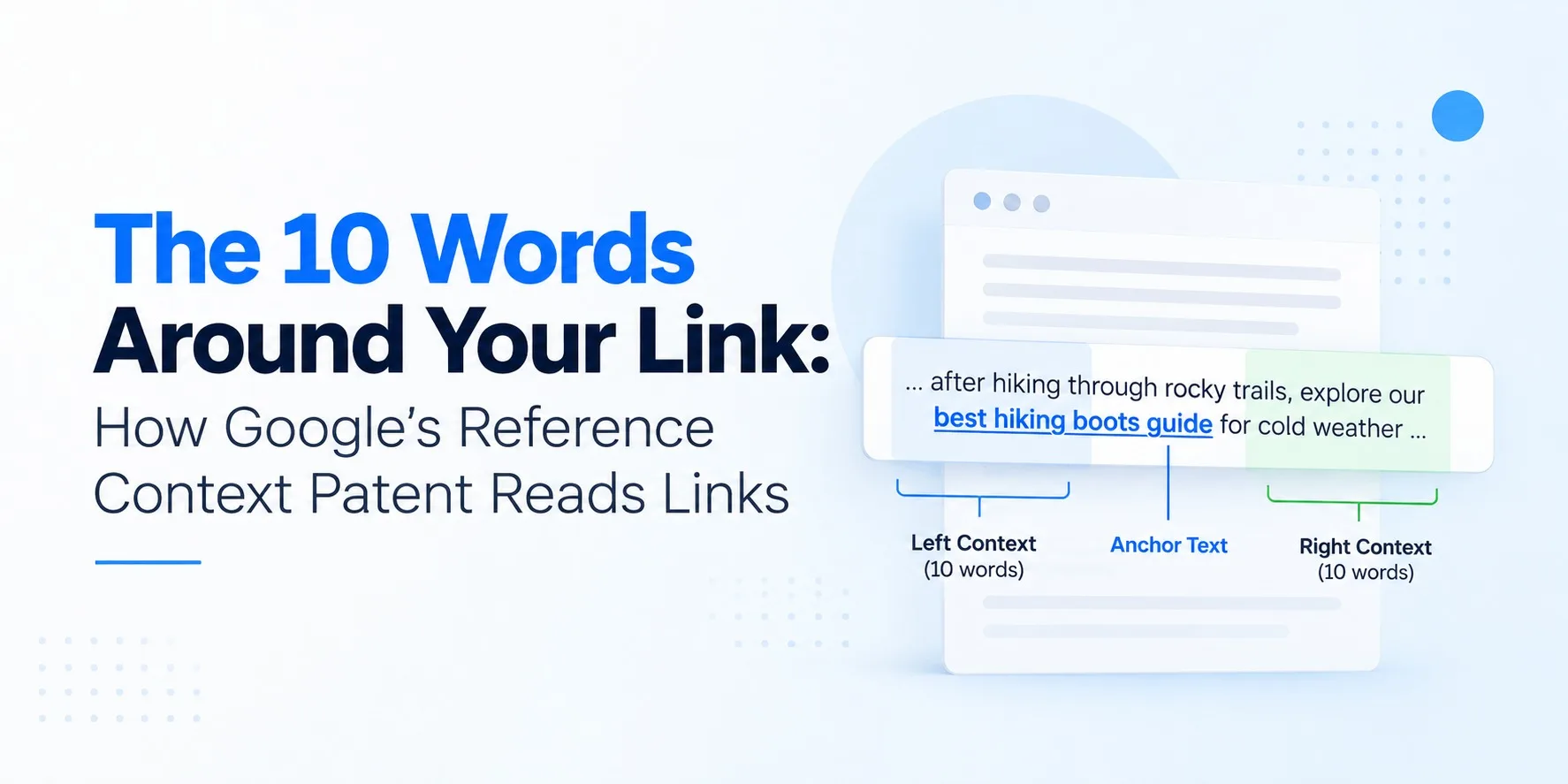
Google’s patent US8577893B1, “Ranking Based on Reference Contexts,” describes a system that reads exactly that: the words on either side of a link. Once you understand how it works, you’ll start reading your own links differently.
A granted patent is no proof that Google runs this system today. It is a precise model of how a search engine could read link context, and that makes it worth understanding.
What the patent is, and why Google wrote it
Google filed the patent in March 2004 and it was granted in November 2013, with Anna Patterson and Paul Haahr as inventors. It was written to blunt link farms, paid links, anchor text spam, Google bombing, and navigation links repeated on every page of a large site.
All of those tactics share one weakness. The links multiply, but the words around them barely change. The patent is built on that observation.
How the mechanism works, step by step
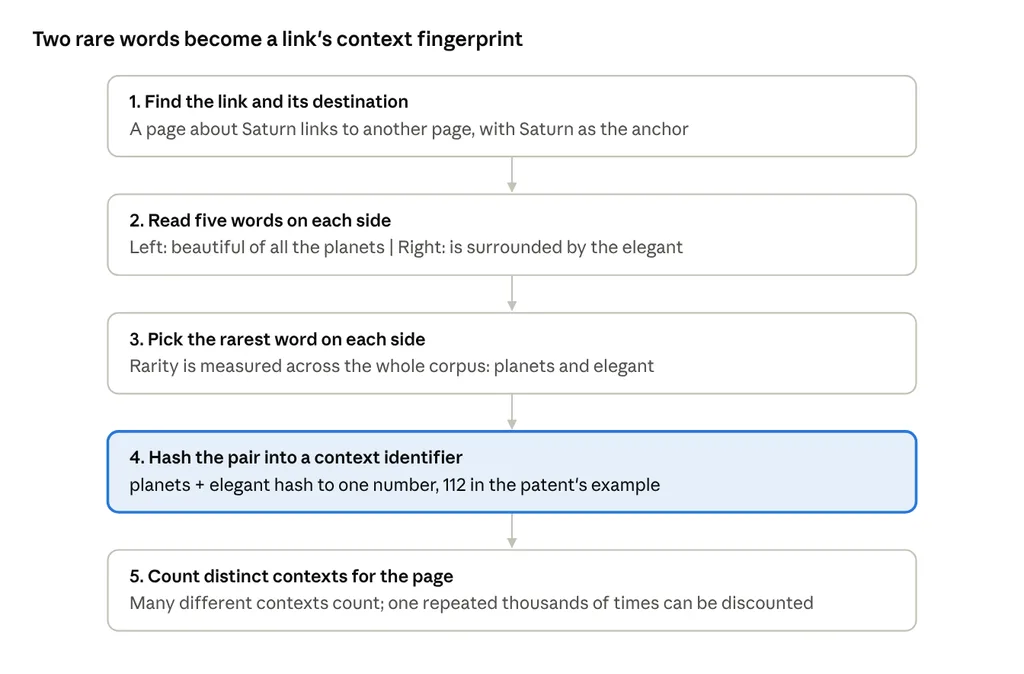
The whole process fits in five steps.
reference context mechanism · 5 stages
The identifier in step 4 is the whole idea: two words stand in for the context of a link.
In practice, the system reads five words on each side of a link and picks the rarest word from each window, measured across the whole document collection. Those two words are hashed into a single number. In the patent’s own example, a sentence about Saturn yields “planets” and “elegant”, which hash to 112.
Every link to a page produces one of these identifiers. The system counts how many distinct contexts a page has, and that count can sit beside link volume, the importance of linking pages, and freshness.
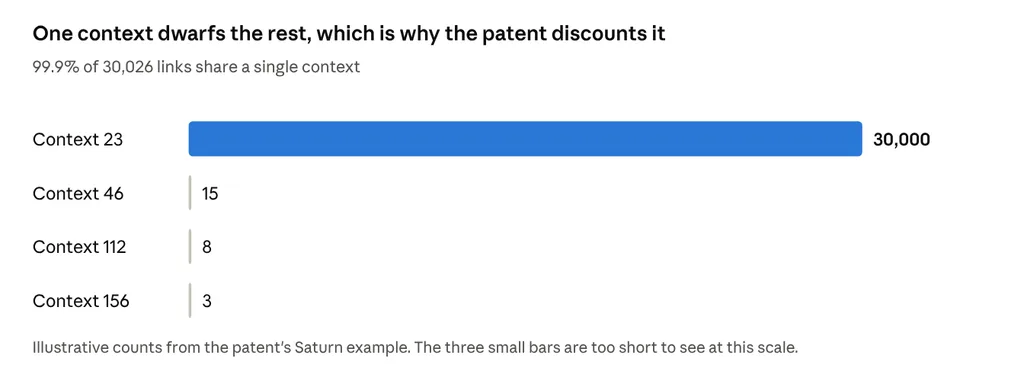
The spread matters as much as the count. When one context appears 30,000 times and the others appear a handful of times, the patent suggests discounting the dominant one. A sudden spike in a single new context can flag the whole page.
US8577893B1, Saturn example · 4 contexts
A footer link repeated across a large site looks exactly like context 23.
Where link context problems hide on real sites
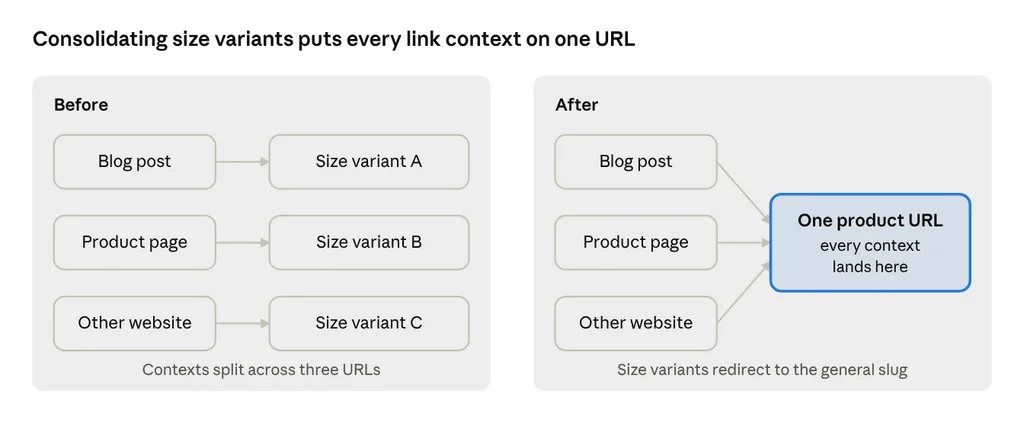
Healthy link numbers can hide context problems. On one e-commerce site I audited recently, every size of a product had its own URL, and writers linked to whichever version they copied. The contexts meant for one product were spread across several pages, so none of them collected the full picture. If your store does the same, merge each product onto one URL and redirect the variants.
size variant consolidation · before and after
Same links, same writers. After the merge, every context they create lands on one page.
Check your highest traffic posts too. A popular post on a topic unrelated to what you sell hands any product it links to a context that describes the wrong thing. Traffic alone doesn’t make a page a good source of internal links.
What this means for your own SEO work
One more caveat before the practical part. A patent never confirms a live ranking factor, so treat it as a model of how link context could be read. Everything below also stands on Google’s published guidance.
Read the sentence before you judge the link
Before judging any backlink or internal link, read the full sentence it sits in. If that sentence explains why the destination is useful, the link earns its place. If the sentence is about something else entirely, a perfect anchor won’t rescue it. Google’s own link best practices ask for descriptive anchors and useful context around them.
Resist the urge to plant unusual keywords next to links because the patent mentions rare words. The words worth having there are the ones a knowledgeable writer would use anyway, and engineered phrasing reads as awkward to people.
Watch for repeated templates
Footer blocks, sidebar widgets and “related products” carousels repeat the same words around the same links on every page. Under the patent, that’s one context counted thousands of times, the exact pattern it proposes to discount.
Repetition on its own is normal. Navigation has to exist. The question to ask is whether a repeated block was built for visitors or built to multiply links. Google’s spam policies define link spam as links created mainly to manipulate rankings, and that definition is the one to audit against.
Consolidate before you build
If links to one product are split across several URLs, every context you earn gets divided. Fixing that is usually the cheapest win in an audit, so merge first and build new links after.
A simple link context audit you can run
Ask these questions of every important link on your site. None of them produce a Google score. They tell you whether a link makes editorial sense and whether it can be found.
| Question | What to check |
|---|---|
| Does the sentence explain the link? | The full sentence, plus the words on either side |
| Is the anchor descriptive? | Whether a reader can predict the destination from the clickable words |
| Is the same context repeated at scale? | Footer, sidebar and widget links sharing identical text |
| Is the destination consolidated? | Size, colour or parameter variants splitting links |
| Can users and crawlers reach it? | A crawlable link pointing to a live page |
On a large site, start with a full crawl of internal links, then read your high-priority pages and any suspicious repetition by hand. The crawl finds the patterns. Reading the sentences tells you what they mean.
Final thoughts
The most striking thing about this patent is how small its idea of context is: two rare words, hashed into a number. Yet that is enough to separate a footer link repeated 30,000 times from a handful of links written by people with something to say.
The advice holds whether or not Google runs this exact system. Read the sentence your link lives in. If it explains why someone should click, you’re in good shape.